






Product Details
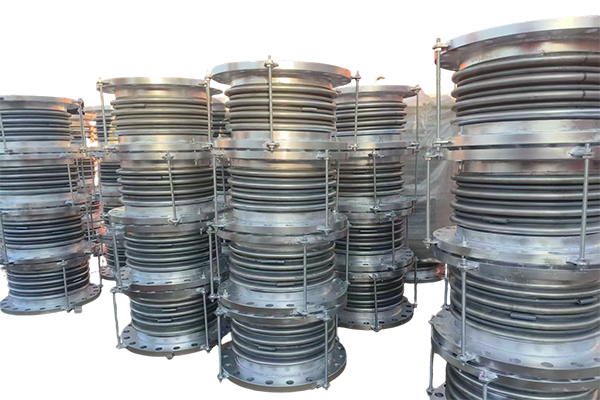
Lateral Expansion Joint
Engineered for Sideways Movement Absorption
A Lateral Expansion Joint is a specialized bellows assembly designed to accommodate offset movement perpendicular to the main pipeline axis.Its primary function is to absorb lateral displacement,which is a common requirement in piping systems where thermal growth causes sideways shifting,or where connecting points are subject to misalignment or settlement.
Core Design Principle&Function
Unlike axial joints that handle compression/extension,lateral joints are engineered to absorb parallel offset between two pipe sections.This is achieved through the flexible deformation of one or more bellows elements,allowing the pipeline to shift sideways without generating destructive bending stresses on equipment nozzles or pipe anchors.
Key Characteristics&Types
Single Bellows with Tie Rods:A basic lateral joint uses a single bellows equipped with tie rods.The tie rods absorb the pressure thrust and allow the joint to extend/compress slightly,but their primary role is to permit lateral deflection by acting as a linkage system.
Universal Expansion Joint:The most common and effective configuration for absorbing large lateral movement.It consists of two bellows connected by a common center spool.This design allows the joint to absorb lateral offset through the combined angular rotation of both bellows,effectively creating an"S"or"Z"flex pattern.
Movement Capability:Specifically rated for a certain amount of lateral deflection(often denoted asΔY).The allowable lateral movement is typically 2-3 times greater than the allowable axial movement for an equivalent bellows.
Hardware:Universal lateral joints are always equipped with tie rod assemblies.These rods connect the two outer pipe ends,absorbing the pressure thrust force and preventing over-extension of the bellows.
Standard Construction&Components
Bellows Pair:Two identical bellows elements(single or multi-ply)made from stainless steel,Inconel®,or other high-performance alloys.
Center Spool:A rigid pipe section that connects the two bellows,determining the effective leverage for lateral movement.
Tie Rod Assemblies:Typically two or more rods with spherical bearings or self-aligning nuts that connect the outer ends of the joint.They are critical for containing pressure thrust and defining the joint's geometry during lateral deflection.
End Connections:Flanged or weld ends for pipeline integration.
Internal Liners&Covers:Standard protective components for media and environmental protection.
Primary Applications
Lateral joints are essential for:
Riser Systems:Where vertical pipe runs experience lateral movement due to platform deflection or thermal bowing.
Pipe Rack Transitions:Connecting piping between structures that may settle or move independently.
Large Diameter Lines with Limited Axial Space:Where lateral offset capability provides movement absorption in a compact footprint.
Connections to Sensitive Equipment:Protecting pumps,turbines,or tanks from pipeline lateral loads caused by thermal growth or external forces.
Absorbing Settlement:In systems where pipe supports or connected structures may settle unevenly over time.
Critical Engineering&Installation Requirements
Proper Anchoring&Guiding:While tie rods absorb pressure thrust,the piping system still requires properly designed guides near the joint to ensure pure lateral movement occurs and to prevent torsional twisting.Main anchors are required at specific locations to react the system's spring forces.
Lateral vs.Axial Movement:Lateral joints can usually absorb a small amount of accompanying axial movement simultaneously.The manufacturer's movement capacity charts(interaction curves)must be consulted to ensure the combined movements are within rated limits.
Pre-Installation Alignment:The joint should generally be installed in a neutral position(not pre-offset)unless specified for a specific cold setting.
 Recommended News
-
Granite Metrology Table: Features and Industrial Applications
2026-10-08 06:00:50
-
Granite Measuring Table: A Guide to Precision Measurement
2026-10-05 05:56:20
-
How Does a Granite Surface Plate Improve Precision Measurement?
2026-10-02 05:56:12
-
Granite Surface Plate Accuracy: Flatness, Tolerance and Standards
2026-09-29 05:19:47
-
What Makes a Precision Granite Surface Plate Accurate?
2026-09-26 04:20:28
Contact Us
—— Hotline:+86 13833738896
—— Hotline:+86 17332777263
—— Email:gongliliangju@163.com
—— Whatsapp:+8615832706206
—— Whatsapp:+8615931710409
—— Address:Beihan Village, Haocun Town, Botou City, Cangzhou City, Hebei Province, China