





NewsDetails
What Is a 3D Flexible Welding Platform and How It Works
author:益商贝贝超管理员 time:2026-02-11 16:04:23 click:131
A 3D Flexible Welding Platform is a precision-engineered fixture base system designed to support accurate, repeatable, and efficient welding operations. It provides a modular working surface where components can be positioned, clamped, and aligned in three dimensions, allowing manufacturers to handle complex structures with high consistency.
In modern industrial environments, product variation and shorter production cycles demand flexible tooling solutions. From the perspective of a professional 3D Flexible Welding Platform manufacturer with standardized production and factory bulk supply capability, flexibility, precision, and scalability are the core advantages that drive adoption across automotive, machinery, rail, and heavy equipment fabrication.
The 3D Flexible Welding Platform transforms traditional fixed jigs into a reconfigurable system that supports multi-model production without sacrificing accuracy.
What Is a 3D Flexible Welding Platform?
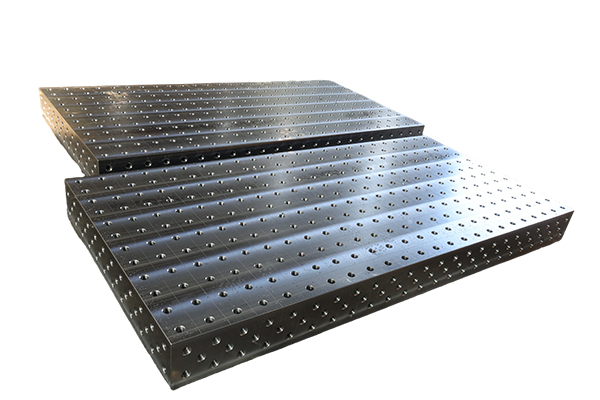
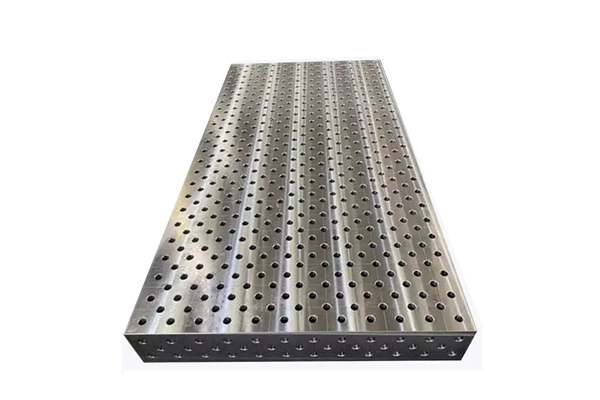
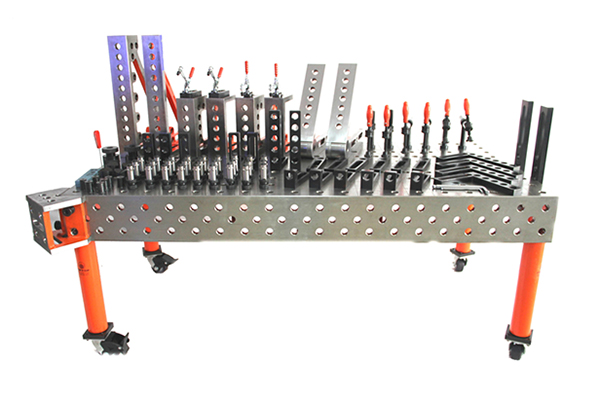
A 3D Flexible Welding Platform is a modular fixture table system composed of precision-machined plates, hole grids, locating pins, clamps, and accessory modules. The platform allows users to build custom welding setups quickly without permanent tooling.
Key characteristics include:
·Three-dimensional positioning capability
·Standardized hole patterns
·High flatness and perpendicularity
·Modular accessory compatibility
·Reusability across different projects
Instead of fabricating a dedicated jig for each part, users assemble a configuration on the 3D Flexible Welding Platform, making production more agile and cost-effective.
Core Structure of a 3D Flexible Welding Platform
The working principle begins with the physical structure.
Platform Table Surface
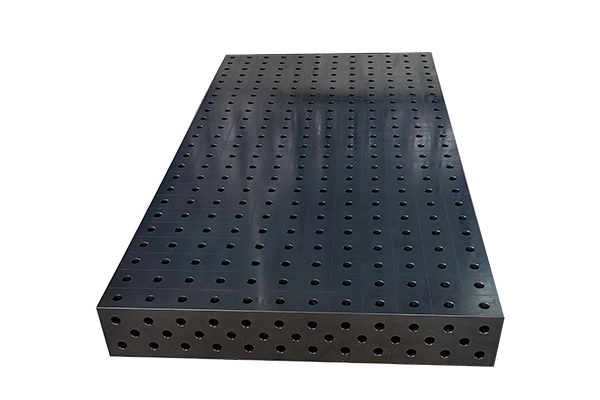
The table is manufactured from high-strength steel or cast material with precision-machined hole patterns. These holes allow clamps and locators to be mounted in both vertical and horizontal directions. Factory production processes ensure surface flatness and positional accuracy across large areas.
Hole Grid System
The standardized grid pattern is the foundation of the 3D Flexible Welding Platform. It enables repeatable positioning and quick reconfiguration. The consistency of the grid comes from CNC machining during manufacturer-level production.
Locating and Clamping Modules
Accessories such as angle plates, stops, pins, and clamps allow parts to be fixed securely. These modules transform the platform into a complete fixturing system for welding operations.
How the 3D Flexible Welding Platform Works
The 3D Flexible Welding Platform works by combining precise reference points with modular components to control part position in three dimensions.
First, the operator installs locating pins into the platform holes to define reference points. Then angle squares and stops are mounted to support the workpiece. Clamps are added to hold components in position during welding.
Because all components reference the same grid system, dimensional accuracy is maintained across batches. Production teams can switch from one assembly to another simply by reconfiguring modules rather than building new fixtures.
This working method dramatically reduces setup time while increasing welding consistency.
Advantages in High Precision Welding
Precision is critical in structural welding.
The 3D Flexible Welding Platform improves accuracy by:
·Maintaining stable geometry
·Reducing distortion during clamping
·Ensuring repeatable alignment
·Supporting multi-directional positioning
Through standardized production and quality inspection, factory-manufactured platforms deliver reliable perpendicularity and flatness that support high-precision welding in demanding environments.
Flexibility for Multi-Model Production
Traditional welding jigs are fixed and inflexible. In contrast, the 3D Flexible Welding Platform adapts to different product geometries.
Manufacturers use the platform to:
·Build prototypes
·Produce small and medium batches
·Switch between models quickly
·Support custom fabrication
From a manufacturer production perspective, flexible tooling allows better utilization of shop floor resources and faster response to changing orders.
Integration with Automation and Robotics
Modern welding increasingly relies on robots and automated systems.
The 3D Flexible Welding Platform integrates easily with:
Robotic welding cells
Automated clamping systems
Sensor-based positioning
Digital layout planning
Factory-level production ensures consistency across multiple platforms, making them suitable for automated lines where precision repeatability is essential.
Durability and Long-Term Stability
A professional 3D Flexible Welding Platform manufacturer designs platforms for long service life.
Durability features include:
·Heat-treated surfaces
·Anti-corrosion coatings
·High-load bearing capacity
·Structural rigidity
These properties support stable operation even under heavy production loads and continuous welding cycles.
Role of Manufacturer and Factory Production
Choosing a platform involves more than just the design concept.
A reliable 3D Flexible Welding Platform manufacturer with integrated factory production and bulk supply capability provides:
·Precision CNC machining
·Surface treatment control
·Quality inspection standards
·Batch consistency
·On-time delivery
Factory-controlled production ensures that every platform meets dimensional and performance expectations for industrial-scale applications.
Typical Applications of a 3D Flexible Welding Platform
The 3D Flexible Welding Platform is widely used in:
·Automotive body and chassis welding
·Construction machinery fabrication
·Rail vehicle assembly
·Aerospace structural parts
·General metal fabrication
Its modular nature supports both custom projects and long-term production programs.
Maintenance and Operational Efficiency
Maintenance of a 3D Flexible Welding Platform is straightforward.
Operators should:
·Clean hole grids regularly
·Inspect clamping modules
·Check flatness periodically
·Protect surfaces from spatter
Proper maintenance preserves precision and extends service life, especially in high-output production environments.
Conclusion: Why the 3D Flexible Welding Platform Matters
The 3D Flexible Welding Platform is a core tool for modern manufacturing where accuracy, flexibility, and efficiency are essential. By replacing fixed jigs with modular systems, manufacturers gain faster setup, consistent quality, and scalable production capability.
Working with a professional factory-based manufacturer with standardized production and bulk supply strength ensures that each 3D Flexible Welding Platform delivers long-term performance across diverse industrial applications.
As production demands evolve, the 3D Flexible Welding Platform continues to support smarter, faster, and more precise welding operations.
References
GB/T 7714:Nee A Y C, Whybrew K. Advanced fixture design for FMS[M]. Springer Science & Business Media, 2012.
MLA:Nee, Andrew Yeh Chris, and Kenneth Whybrew. Advanced fixture design for FMS. Springer Science & Business Media, 2012.
APA:Nee, A. Y. C., & Whybrew, K. (2012). Advanced fixture design for FMS. Springer Science & Business Media.
3D Flexible Welding Platform solutions built on manufacturer-level production and factory quality control remain a foundation for advanced industrial welding systems.
 Recommended Products
 Contact Us
—— Hotline:+86 13833738896
—— Hotline:+86 17332777263
—— Email:gongliliangju@163.com
—— Whatsapp:+8615832706206
—— Whatsapp:+8615931710409
—— Address:Beihan Village, Haocun Town, Botou City, Cangzhou City, Hebei Province, China