






NewsDetails
Welding Table Supply Chain Overview: From Foundry to Factory Floor
author:jinchang time:2026-07-08 09:18:03 click:167
Understanding the supply chain behind a welding table is essential for purchasing professionals who need to evaluate supplier reliability, manage lead times, and mitigate procurement risks. Unlike commodity industrial equipment, a precision welding table involves specialized materials, controlled manufacturing processes, and multi-stage quality verification that create a complex supply chain with multiple potential bottlenecks. This welding table supply chain overview maps the journey from raw material sourcing through final delivery and identifies the critical decision points where supply chain understanding protects the buyer.
Raw Material Sourcing: Cast Iron and Steel
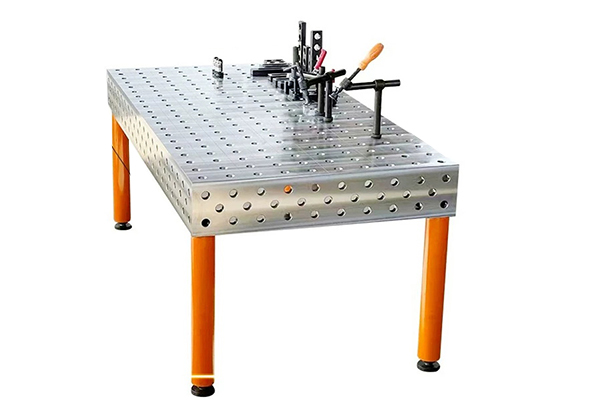
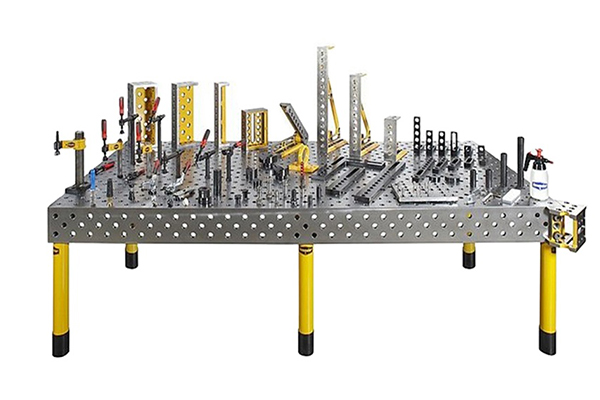
The supply chain begins at the foundry. Welding table base plates are primarily manufactured from cast iron (grades GG-20 through GG-30) or steel plate. Cast iron requires iron ore, coke, and limestone, processed through cupola or electric furnaces with controlled chemistry to achieve the specified carbon equivalent, silicon content, and graphite structure. Steel plate sourcing follows standard steel supply chains with additional requirements for surface quality and flatness prior to machining. Supply disruptions at the foundry level - whether from raw material shortages, energy cost fluctuations, or environmental regulation changes - can add 4-8 weeks to lead times. Reputable welding table manufacturers maintain strategic foundry partnerships with secondary sourcing agreements to buffer against these disruptions.
Casting and Initial Quality Control
After raw material sourcing, castings undergo initial formation and quality verification. The casting process for a welding table base plate requires controlled pouring temperatures, proper gating and risering design, and sufficient cooling time to prevent internal defects such as porosity, inclusions, and shrinkage cavities. Initial quality control includes visual inspection, dimensional verification of rough casting dimensions, and non-destructive testing (typically ultrasonic or radiographic) for critical applications. Casting defects discovered at this stage are far less expensive to address than defects found after machining - a single base plate rejection after machining represents a loss of $500-$2,000 in material and labor. Manufacturers with robust supply chains maintain casting yield rates above 92 percent, while less controlled operations experience yields as low as 75-80 percent.
Machining: The Value-Added Core of the Supply Chain
Machining transforms raw castings into precision welding table surfaces. This stage represents the largest value-added step in the supply chain and the most significant capacity bottleneck. Key machining operations include: surface grinding to achieve flatness specifications (typically 2-4 passes on a large CNC surface grinder), hole drilling and reaming to achieve positional accuracy and diameter tolerance, and edge machining for datum surfaces. Climate-controlled machining environments (temperature held to plus or minus 1 degree Celsius) are necessary for precision-grade tables. A single large CNC surface grinder can process 2-4 base plates per day, making machining capacity a genuine constraint during periods of high demand. Understanding a manufacturer's machining capacity helps purchasing teams anticipate realistic lead times and avoid suppliers who over-promise.
Stress Relief and Material Stabilization
Stress relief is a time-intensive but non-negotiable step in the welding table supply chain overview. After rough machining, base plates undergo thermal stress relief: 8-12 hours in a controlled furnace at 500-600 degrees Celsius, followed by slow cooling over 6-8 hours. Some manufacturers perform a second stress relief cycle after finish machining. Total stress relief processing time for a single batch is 24-48 hours including furnace loading and unloading. This step cannot be accelerated without compromising dimensional stability. Manufacturers who skip or abbreviate stress relief to shorten lead times produce tables that distort during service - a quality failure that may not become apparent for months after delivery.
Quality Verification and Calibration
Every finished welding table undergoes quality verification before shipment. CMM inspection measures flatness, hole positions, and dimensional accuracy against specifications. Results are documented in an individual calibration certificate. For large production orders, statistical sampling may replace 100 percent inspection, though most quality-conscious manufacturers inspect every base plate individually. Calibration data is archived by the manufacturer and provided to the customer. This quality verification step adds 1-2 days to the supply chain timeline but represents the manufacturer's final commitment to delivering a product that meets its published specifications.
Logistics: Shipping Heavy Industrial Equipment
Shipping a welding table base plate weighing 500-2,000 kg requires specialized logistics planning. Base plates must be shipped flat (never on edge) on reinforced pallets or cradles that prevent shifting and damage during transit. Domestic ground shipping typically requires 3-7 days depending on distance, while international shipping adds 4-8 weeks including customs clearance. Freight costs for heavy base plates represent 5-15 percent of the product value, a significant factor in total procurement cost. Reputable manufacturers include shipping protection specifications in their packaging design and offer freight insurance options. Local distributors with regional inventory can eliminate long shipping lead times for standard table sizes, an important advantage for time-sensitive projects.
Supply Chain Risk Management for Buyers
Purchasing teams should assess supply chain resilience when selecting a welding table supplier. Key risk factors include: single-source foundry dependency (what happens if the foundry has a production stoppage?), machining capacity constraints (can the manufacturer scale production if demand spikes?), geographic concentration risk (are foundry, machining, and assembly in the same region vulnerable to disruption?), and logistics chain vulnerability (is the shipping route reliable and are there alternative routes?). Mitigation strategies include maintaining relationships with two qualified suppliers, ordering critical tables well in advance of need dates, and negotiating consignment inventory arrangements for high-volume standardized table sizes.
FAQ: Welding Table Supply Chain Overview
What is the typical lead time for a welding table?
Standard-size tables from manufacturers with inventory typically ship within 1-2 weeks. Custom-specified tables requiring new casting and machining run 6-12 weeks. During periods of high demand, lead times may extend to 16 weeks. Always confirm current lead times before placing orders.
Why do welding table lead times vary so much between suppliers?
Lead time variation reflects supply chain maturity. Manufacturers with integrated foundries, in-house machining, and inventory buffers deliver consistently. Manufacturers who outsource multiple supply chain steps experience longer and more variable lead times due to coordination complexity and capacity constraints at subcontractors.
Should I source welding tables domestically or from overseas manufacturers?
It depends on your priority. Domestic sourcing offers shorter lead times, easier quality verification, and lower shipping risk. Overseas sourcing (primarily China and India) offers lower unit prices but longer lead times (8-16 weeks), higher shipping costs, and more limited quality recourse. For precision applications, domestic sourcing is generally recommended.
How can I verify a supplier's manufacturing capability?
Request a factory tour or virtual facility visit. Ask about foundry sourcing, machining equipment, stress relief processes, and quality inspection capabilities. Request sample calibration certificates. Contact three references with applications similar to yours. These steps reveal more about manufacturing capability than any specification sheet.
Conclusion
A thorough welding table supply chain overview reveals that manufacturing a precision welding table involves far more than machining a flat plate. From controlled foundry operations through multi-stage machining, stress relief treatment, quality verification, and specialized logistics, each step in the supply chain affects the final product's quality, delivery timeline, and cost. Understanding these steps enables purchasing teams to evaluate suppliers accurately, set realistic expectations for lead times and pricing, and implement risk mitigation strategies that protect production schedules. In an industry where quality cannot be inspected into a product but must be built into the process, supply chain transparency is not optional - it is essential.
References
Bi, Z.M. and Zhang, W.J. (2001). Flexible fixture design and automation: Review and future directions. International Journal of Advanced Manufacturing Technology, 17(4), 266-277.
Rong, Y. and Bai, Y. (2000). Modular fixture element assembly and accuracy analysis. International Journal of Production Research, 38(14), 3103-3114.
Boerma, J.R. and Kals, H.J.J. (1989). FIXES, a system for automatic selection of set-up clamping elements. Annals of the CIRP, 38(1), 443-446.
Nee, A.Y.C., Kumar, S. and Prombanpong, S. (1991). A feature-based classification scheme for fixtures. International Journal of Machine Tools and Manufacture, 31(1), 1-13.
 Recommended Products
 Contact Us
—— Hotline:+86 13833738896
—— Hotline:+86 17332777263
—— Email:gongliliangju@163.com
—— Whatsapp:+8615832706206
—— Whatsapp:+8615931710409
—— Address:Beihan Village, Haocun Town, Botou City, Cangzhou City, Hebei Province, China