





NewsDetails
Production Process of 3D Flexible Welding Platform Manufacturer
author:jinchang time:2026-09-04 15:39:26 click:110
The difference between a precision 3D flexible welding platform and an overpriced flat plate comes down to how it was made. Every specification on a catalog page - flatness tolerance, hole position accuracy, load capacity - reflects decisions made throughout the manufacturing process by the 3D flexible welding platform manufacturer. Understanding that process helps procurement decision-makers and manufacturing engineers evaluate supplier quality more accurately and distinguish between platforms that will perform reliably for 10 years and those that will cause problems within the first year.
Raw Material Sourcing and Foundry Selection
The production process of a 3D flexible welding platform manufacturer begins at the foundry with material selection. Cast iron for industrial welding tables is produced in grades ranging from low-grade recycled material through premium controlled-chemistry melts. A quality foundry uses virgin iron, scrap returns from known sources, and carefully controlled additions of silicon, carbon, and trace elements to achieve the target grade specification - typically GG-25 or GG-30 for industrial welding platforms. The chemistry is verified through spectrographic analysis, and heat records document the melt for traceability. Material that does not meet chemistry specifications is rejected before it ever becomes a casting. This discipline at the foundry stage is the first indicator of whether a manufacturer takes quality seriously.

Casting Formation and Initial Quality Gates
The liquid iron is poured into molds designed with proper gating and risering to ensure complete filling and proper solidification. After cooling, the rough casting is removed from the mold and inspected for surface defects, dimensional compliance with the rough drawing, and internal soundness through non-destructive testing where required by the application. A 3D flexible welding platform manufacturer performing rigorous quality control rejects castings with porosity, cold shuts, or dimensional deviations at this stage, accepting only castings that will machine cleanly and meet final specifications. This first-pass quality gate prevents the cost and disruption of rejecting finished plates that fail inspection.
CNC Machining: Surface Grinding and Hole Operations
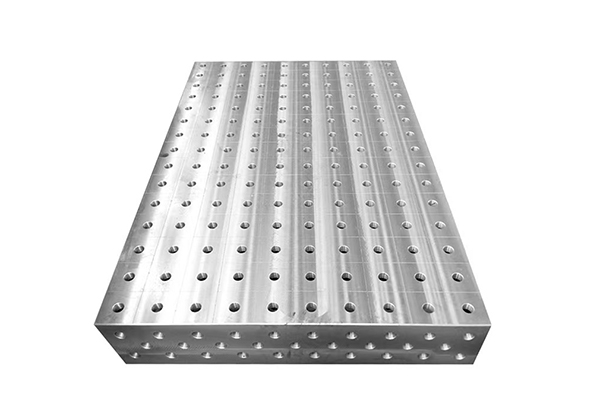
Machining is where the rough casting becomes a precision platform. The process typically follows a sequence: rough machining of the base surfaces and rib structure, stress relief treatment, finish machining of the working surface, and hole drilling or reaming. The working surface receives multiple passes on a CNC surface grinder that removes material incrementally while monitoring flatness in real time. Hole operations use CNC drill presses or machining centers with programmed tool paths that reference the plate edge datums. For a 3D flexible welding platform with precision-reamed holes, each hole is individually reamed to H7 tolerance - a process that takes significantly longer than simple drilling but delivers the positional and diameter accuracy that modular fixturing demands. The 3D flexible welding platform manufacturer controls machining environment temperature to within 1 degree Celsius during precision operations to prevent thermal expansion from affecting cutting accuracy.
Stress Relief: The Step That Determines Long-Term Stability
After rough machining but before finish machining, the partially completed plate undergoes stress relief - a controlled thermal treatment that equalizes internal stresses introduced during solidification and machining. The plate enters a furnace at room temperature, is heated gradually to 500 to 600 degrees Celsius, held at temperature long enough for the entire cross-section to reach equilibrium, and then cooled slowly according to a defined schedule. A complete stress relief cycle including loading, heating, holding, cooling, and unloading takes 24 to 36 hours. A quality 3D flexible welding platform manufacturer performs this treatment at least twice during the manufacturing sequence. Skipping or abbreviating stress relief is the most common way that budget manufacturers cut costs - and the most certain way to deliver a platform that will distort progressively during production use.
CMM Inspection and Calibration Certification
Every finished 3D flexible welding platform undergoes coordinate measuring machine inspection before shipment. The CMM measures surface flatness at 50 to 200 points depending on plate size, hole positions across the full grid, hole diameters, and surface roughness. These measurements are compared against the published specification for the platform grade. A quality 3D flexible welding platform manufacturer issues an individual calibration certificate for each plate, documenting the actual measured values rather than stating that the plate meets a generic specification. The certificate travels with the plate to the customer, providing evidence of quality that supports the manufacturer's warranty and enables the customer to verify performance upon receipt. Plates that do not meet specification are re-machined or scrapped - not shipped with a disclaimer.
Component Manufacturing and Assembly Verification
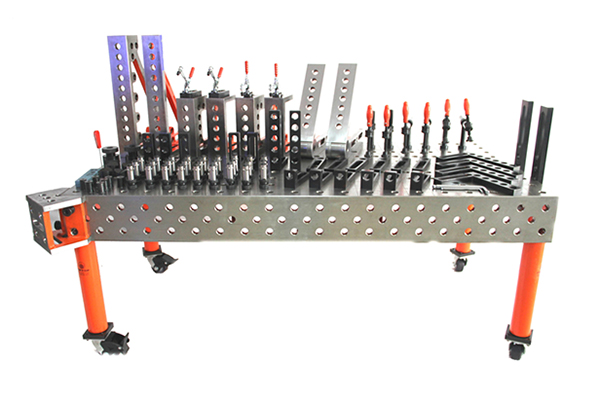
For a complete 3D flexible welding platform system, the 3D flexible welding platform manufacturer also produces or sources the modular components: locating pins, support posts, angle brackets, and clamping hardware. Component manufacturing follows similarly rigorous standards: ground bearing surfaces on pins, hardened and precision-ground clamping elements, and load testing of hydraulic components to 1.5 times rated capacity. Components are inspected against specification before assembly into kits, and random sampling verification continues throughout the production run. The complete system - base plate plus components - is verified functionally before packing, ensuring that the customer receives a working system rather than a collection of individually compliant parts that may not fit together properly.
Packaging, Shipping, and Customer Receipt
The final stage of the production process for a 3D flexible welding platform manufacturer is packaging and logistics. Base plates weighing hundreds of kilograms require specialized packaging: steel channel cradles that prevent the plate from shifting during transit, protective coatings to prevent surface damage, and lifting points designed for safe handling by forklift or overhead crane. The manufacturer typically includes the calibration certificate, material test reports, an assembly manual for the clamping system, and basic setup guidance in the shipment documentation. Upon receipt, the customer should verify the plate against the calibration certificate and report any discrepancies immediately - before the plate is placed into service and before the window for filing a damage claim with the carrier closes.
FAQ: Production Process of 3D Flexible Welding Platform Manufacturer
How can I verify that a manufacturer performs proper stress relief?
Ask for the stress relief process documentation as part of the purchase specification. A quality 3D flexible welding platform manufacturer will provide written confirmation of the number of cycles, temperatures, and durations. If the manufacturer is unwilling to share this documentation, treat it as a red flag.
Why do some platforms cost significantly more than others of similar size?
Price differences typically reflect manufacturing discipline: controlled-chemistry foundry material versus recycled scrap, multiple stress relief cycles versus minimal treatment, CNC precision machining versus manual operations, individual CMM inspection versus batch sampling. Each of these differences adds cost but also adds the quality and longevity that justify the investment.
What is included in the delivery from a quality manufacturer?
A quality 3D flexible welding platform manufacturer typically includes: the calibrated base plate with individual inspection certificate, material test reports, an assembly manual, and component kit contents list. Premium suppliers also include installation guidance and basic setup documentation templates.
Should I witness the factory acceptance test for a major purchase?
For orders above $15,000, a witnessed FAT is strongly recommended. You can observe the inspection process, ask questions about manufacturing practices, and verify that the supplier's quality standards match what was specified. Most quality manufacturers welcome customer visits or offer virtual tour programs.
Conclusion
The production process of a 3D flexible welding platform manufacturer determines whether the platform delivers a decade of reliable service or begins degrading within the first year. Foundries using controlled-chemistry melts, multiple stress relief cycles, CNC precision machining, individual CMM calibration, and rigorous component quality control add cost at every stage - but that cost is what separates platforms that hold their specifications through years of daily production use from those that do not. Procurement decision-makers who understand the manufacturing process are better equipped to evaluate supplier claims, compare offerings accurately, and select platforms that will perform as specified throughout their service life.
References
Bi, Z.M. and Zhang, W.J. (2001). Flexible fixture design and automation: Review and future directions. International Journal of Advanced Manufacturing Technology, 17(4), 266-277.
Rong, Y. and Bai, Y. (2000). Modular fixture element assembly and accuracy analysis. International Journal of Production Research, 38(14), 3103-3114.
Kumar, S. and Nee, A.Y.C. (1995). Development of a modular fixture design system. Journal of Intelligent Manufacturing, 6(4), 263-274.
Nee, A.Y.C., Kumar, S. and Prombanpong, S. (1991). A feature-based classification scheme for fixtures. International Journal of Machine Tools and Manufacture, 31(1), 1-13.
 Recommended Products
 Contact Us
—— Hotline:+86 13833738896
—— Hotline:+86 17332777263
—— Email:gongliliangju@163.com
—— Whatsapp:+8615832706206
—— Whatsapp:+8615931710409
—— Address:Beihan Village, Haocun Town, Botou City, Cangzhou City, Hebei Province, China