





NewsDetails
Modular Welding Platform in Batch Production: Cut Costs, Scale Output
author:jinchang time:2026-06-05 16:49:48 click:166
Batch production environments face a constant tension: each batch may run for days or weeks, but changeover between batches must be fast enough to keep overall equipment effectiveness (OEE) high. A modular welding platform resolves this tension by providing production-grade workholding that can be reconfigured between batches in minutes — not the hours or days required to swap dedicated fixtures. This article explores how a modular welding platform in batch production drives down per-part fixture cost, improves changeover speed, and maintains the repeatability that batch quality demands.
The Batch Production Challenge: Changeover vs. Fixture Cost
In batch production, every minute of changeover is a minute the welding station produces nothing. Traditional dedicated fixtures offer fast load/unload within a batch but incur high upfront cost ($2,000–$15,000 per fixture) and long lead times (4–12 weeks for design and fabrication). When a factory runs 20–50 different parts in batches, the total fixture investment becomes substantial. A modular welding platform replaces this portfolio of dedicated fixtures with a single reconfigurable system, converting fixture cost from a large capital outlay into a manageable operational expense.
How a Modular Welding Platform Works in Batch Production
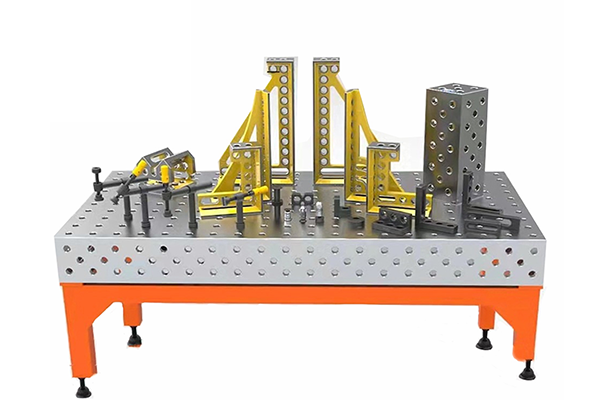
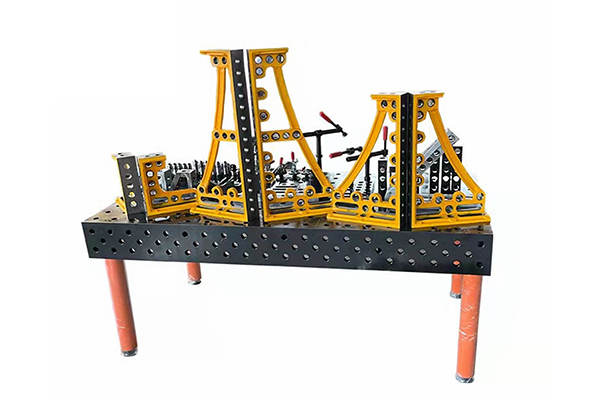
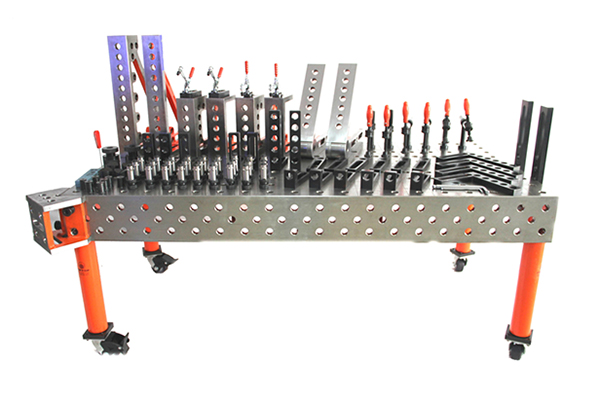
A modular welding platform in batch production operates on a simple cycle: configure, weld, document, disassemble, reconfigure. At the start of a batch run, the operator assembles the fixture configuration on the modular base plate using standard components — supports, angle brackets, strap clamps, and locating pins. The configuration is verified, the batch is welded, and the completed fixture setup is photographed and archived. When the batch finishes, components are returned to storage, ready for the next batch's configuration. No fixture is idle on a shelf — every component is shared across batches.
Changeover Time Reduction: The Numbers
Industry data and shop-floor experience consistently show that modular fixture changeovers take 10–25 minutes, compared to 1–4 hours for dedicated fixture swaps (which often involve locating and retrieving stored fixtures, bolting them to the table, and verifying alignment). In a facility running 15 batch changeovers per week, saving just 90 minutes per changeover adds up to 22.5 hours of recovered production time per week — equivalent to nearly three additional production shifts per month. A modular welding platform delivers this time saving as a direct, measurable contribution to OEE.
Maintaining Repeatability Across Batches
A common concern with modular fixturing is whether positional accuracy holds when a fixture is disassembled and rebuilt for a later batch of the same part. The answer is yes — provided the system and procedures are sound. Quality modular welding platforms use base plates machined to ±0.05 mm flatness and components with precision-ground mounting surfaces. When fixture configurations are documented with grid coordinates and verified with a dial indicator or digital probe upon reassembly, positional repeatability within ±0.1 mm is standard. This level meets or exceeds the requirements of most batch welding applications in structural, industrial, and general manufacturing sectors.
Per-Part Fixture Cost Analysis
Consider a mid-size fabrication shop running 30 different parts in batches of 50–500 units. Under the dedicated fixture model, the shop invests approximately $150,000 in fixtures (30 parts × $5,000 average). Each fixture is used only during its batch window, sitting idle the rest of the year. Under the modular approach, a modular welding platform with a comprehensive clamping kit costs $8,000–$15,000 and serves all 30 parts. Per-part fixture cost drops from $5,000 to approximately $250–$500 (amortized over the platform's 10+ year service life and all part families). This 90–90% reduction in fixture capital is the primary financial driver for modular adoption in batch production.
Scalability: Adding Capacity Without Adding Fixtures
When production volume increases, the modular approach scales linearly and affordably. Adding capacity means purchasing an additional base plate and clamping kit — not designing, waiting for, and paying for a new dedicated fixture. In fast-growing operations (e.g., renewable energy fabrication, construction equipment manufacturing), this scalability is critical. A modular welding platform in batch production allows the shop to double or triple welding capacity within days, simply by deploying additional modular stations. Dedicated fixtures cannot match this responsiveness.
Best Practices for Batch Production on a Modular Platform
To get the most from a modular welding platform in batch production, follow these practices: (1) Assign one base plate per welding station to avoid changeover bottlenecks. (2) Create a digital fixture library with photographs, grid coordinates, and setup notes for every batch configuration. (3) Pre-stage clamping kits by part family to accelerate changeovers. (4) Train all welders on the same setup SOPs to ensure consistency regardless of who builds the fixture. (5) Schedule batch sequences to group similar part families, minimizing the number of component changes between batches.
Real-World ROI: A Case Study
A structural steel fabricator in the Midwest United States running 25 part numbers in batches of 100–300 units transitioned from dedicated fixtures to a modular welding platform in batch production. Results after 12 months: fixture capital reduced by $115,000, average changeover time decreased from 2.5 hours to 20 minutes, and OEE improved from 68% to 81%. The modular system paid for itself within 4 months, and the shop has since expanded to 3 modular stations handling 40 part numbers with no additional dedicated fixtures.
FAQ: Modular Welding Platform in Batch Production
Is a modular welding platform rigid enough for heavy batch welding?
Yes. Systems with cast iron or heavy steel base plates (40–50 mm thick) and high-force clamps provide rigidity comparable to dedicated fixtures. For heavy structural welding (parts over 500 kg), choose a platform rated for the load and verify deflection specifications with the manufacturer.
How does modular fixturing affect batch quality consistency?
When setup procedures are standardized and documented, batch-to-batch quality consistency is equal to or better than dedicated fixtures. The key discipline is verifying datum alignment after every reassembly — a 60-second check that prevents positional errors.
Can modular welding platforms be used with automated welding systems?
Yes. Modular platforms can be integrated with collaborative robots (cobots), robotic welding arms, and automated positioners. The repeatable fixture setup ensures the automation program aligns with the workpiece, which is essential for batch consistency.
What is the typical ROI period for a modular welding platform in batch production?
Most shops report ROI within 3–8 months, depending on batch variety and fixture replacement volume. The primary savings come from eliminated dedicated fixture costs and recovered changeover time.
How many part configurations can one modular system handle?
A well-equipped modular welding platform with a comprehensive clamping kit can handle virtually unlimited part configurations. The constraint is not the system's capability but the operator's ability to document and recall setups efficiently.
Conclusion
A modular welding platform in batch production is not just an alternative to dedicated fixtures — it is a superior operational strategy. By replacing a portfolio of idle, expensive dedicated fixtures with a single shared reconfigurable system, batch manufacturers reduce fixture capital by 90% or more, cut changeover time by 75–85%, and maintain production-grade repeatability across all batch runs. For any welding operation running multiple part numbers in batches, the modular approach delivers faster ROI, greater scalability, and stronger OEE than the traditional dedicated fixture model.
References
Rong, Y. & Bai, Y. (2000). Modular fixture element assembly and accuracy analysis. International Journal of Production Research, 38(14), 3103–3114.
Bi, Z.M. & Zhang, W.J. (2001). Flexible fixture design and automation: Review and future directions. International Journal of Advanced Manufacturing Technology, 17(4), 266–277.
Boerma, J.R. & Kals, H.J.J. (1989). FIXES, a system for automatic selection of set-up clamping elements. Annals of the CIRP, 38(1), 443–446.
Nee, A.Y.C., Kumar, S. & Prombanpong, S. (1991). A feature-based classification scheme for fixtures. International Journal of Machine Tools and Manufacture, 31(1), 1–13.
 Recommended Products
 Contact Us
—— Hotline:+86 13833738896
—— Hotline:+86 17332777263
—— Email:gongliliangju@163.com
—— Whatsapp:+8615832706206
—— Whatsapp:+8615931710409
—— Address:Beihan Village, Haocun Town, Botou City, Cangzhou City, Hebei Province, China