





NewsDetails
How a 3D Flexible Welding Platform Manufacturer Ensures Quality: From Design to Delivery
author:jinchang time:2026-06-28 18:59:06 click:80
The quality of a 3D flexible welding system is determined long before it reaches the factory floor - it is engineered into every specification, machined into every surface, and verified through every test during manufacturing. Understanding how a 3D flexible welding platform manufacturer ensures quality helps purchasing teams evaluate suppliers, compare specifications accurately, and select a system that delivers consistent performance over years of service. This article examines the quality processes that distinguish reputable manufacturers from commodity suppliers in the modular fixturing industry.
Material Selection and Metallurgical Quality
Quality begins with material specification. A 3D flexible welding platform manufacturer that prioritizes quality specifies cast iron grades with controlled chemistry (typically GG-25 or equivalent), verified through spectrographic analysis with certification traceable to the foundry. The material must contain the correct carbon equivalent, graphite structure, and hardness range to achieve the required combination of wear resistance, vibration damping, and machinability. Inferior manufacturers use recycled materials with inconsistent chemistry, producing base plates that wear unevenly, develop stress cracks, and lose flatness within months. Request material test certificates and foundry certifications before purchasing.
Precision Machining and Process Control
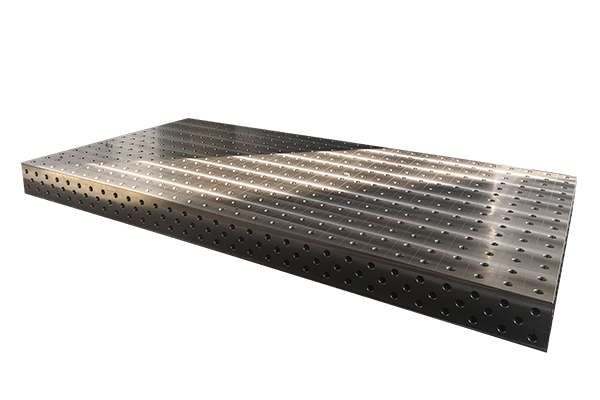
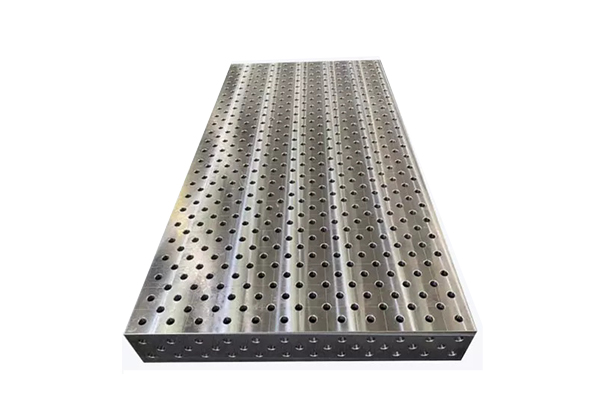
The machining processes that transform raw castings into precision base plates define how a 3D flexible welding platform manufacturer ensures quality at the production level. Reputable manufacturers operate in climate-controlled machining facilities where temperature variation is held to plus or minus 1 degree Celsius during critical operations. CNC grinding produces the flat working surface, with multiple passes removing material incrementally to prevent heat-induced stress. Hole drilling uses coordinate-measuring-machine-controlled tool paths with automatic tool wear compensation. Every machined surface undergoes dimensional inspection at multiple stages - typically three inspection gates for critical operations. This process control ensures every base plate meets the published specification.
Stress Relief and Material Stabilization
Perhaps the most important quality step that separates premium manufacturers from budget alternatives is stress relief treatment. A 3D flexible welding platform manufacturer committed to quality subjects every casting to multiple stress relief cycles: an initial furnace treatment after rough casting, a second cycle after rough machining, and sometimes a third after finish machining. These treatments - typically 8-12 hours at 500-600 degrees Celsius followed by controlled cooling - equalize internal stresses that would otherwise cause gradual distortion during service. Without proper stress relief, a base plate may appear flat when new but develop 0.05-0.15 mm of distortion within the first year as internal stresses equalize under thermal cycling from welding.
Calibration and Metrology Standards
Verification is essential to how a 3D flexible welding platform manufacturer ensures quality. After machining, every base plate undergoes full calibration on a coordinate measuring machine (CMM) with temperature compensation. The CMM program measures surface flatness at 50-200 points depending on plate size, hole positions across the entire grid, hole diameters, and surface finish. Results are documented in an individual calibration certificate for each plate, not a generic specification sheet. Premium manufacturers include CMM data files with each plate, enabling purchasers to verify performance upon receipt. This transparency is the strongest indicator of manufacturing quality confidence.
Component Manufacturing Consistency
Base plate quality alone does not define system performance - every component in the system must meet equivalent standards. A quality 3D flexible welding platform manufacturer applies the same precision to locating pins, support posts, clamping arms, and accessory components. Locating pins are ground to g6 tolerance (providing a precision fit within H7 tolerance holes), support post surfaces are ground flat to within 0.01 mm, and clamping components are load-tested to 1.5 times rated capacity. Manufacturers that source components from multiple suppliers without incoming inspection acceptance testing introduce variability that degrades system accuracy. Ask about component manufacturing and inspection processes during supplier evaluation.
Testing Protocols Before Shipment
Before any system leaves the factory, comprehensive testing demonstrates how a 3D flexible welding platform manufacturer ensures quality in the finished product. Standard tests include: flatness verification under no-load and loaded conditions, hole position verification across the full grid, clamp force verification for all included hydraulic components, and function testing of adjustable support mechanisms. Some manufacturers perform thermal cycling tests to verify dimensional stability under simulated welding conditions. Request a copy of the factory acceptance test (FAT) procedure during supplier evaluation and, for major purchases, arrange for a witnessed FAT to observe testing in person.
Warranty and Post-Sale Support
A manufacturer's warranty terms reveal their confidence in product quality. Leading 3D flexible welding platform manufacturer warranties typically cover base plates for 5-10 years against manufacturing defects, with components covered for 1-3 years. Beyond warranty coverage, evaluate the manufacturer's technical support capability: do they offer application engineering assistance for complex fixturing requirements? Do they maintain spare parts inventory for fast replacement? Do they provide training for setup and maintenance best practices? A manufacturer that stands behind its products with comprehensive support demonstrates commitment to quality that extends beyond the production floor.
FAQ: 3D Flexible Welding Platform Manufacturer Quality
What certifications should a quality manufacturer hold?
ISO 9001:2015 certification is the minimum standard. For suppliers serving automotive or aerospace OEMs, IATF 16949 or AS9100 certification demonstrates capability to meet demanding quality requirements. Material certifications should be ISO 10474 compliant.
How can I verify manufacturer quality claims before purchasing?
Request three things: (1) individual CMM calibration certificates for base plates rather than generic specifications, (2) material test certificates with spectrographic analysis, (3) references from three customers with similar applications. Site visits and witnessed factory acceptance tests provide the strongest verification.
What is the typical failure rate for quality-manufactured platforms?
Premium manufacturers report field failure rates below 0.5 percent for base plates over 10 years of service. Component failure rates are higher - 1-3 percent annually for locating pins and clamping components under normal use. Higher rates indicate quality issues.
Does a higher purchase price guarantee better quality?
Not necessarily, but price correlates with quality more strongly in modular fixturing than in many equipment categories. The cost difference between a premium and budget platform (typically 20-40 percent) reflects different material quality, manufacturing precision, and quality verification investment.
Conclusion
Understanding how a 3D flexible welding platform manufacturer ensures quality enables informed purchasing decisions that protect both capital investment and production quality. From material selection and controlled machining through multiple stress relief cycles, comprehensive CMM calibration, component consistency testing, and factory acceptance testing, quality manufacturers invest in processes that deliver verifiable, reliable performance. When evaluating suppliers, look beyond the specification sheet to the manufacturing processes, quality certifications, documentation practices, and warranty commitments that separate true quality manufacturers from commodity suppliers. The investment in a quality platform pays dividends in accuracy, longevity, and production reliability.
References
Rong, Y. and Bai, Y. (2000). Modular fixture element assembly and accuracy analysis. International Journal of Production Research, 38(14), 3103-3114.
Bi, Z.M. and Zhang, W.J. (2001). Flexible fixture design and automation: Review and future directions. International Journal of Advanced Manufacturing Technology, 17(4), 266-277.
Masood, S.H. and Soar, R.C. (2003). Intelligent modular fixture design for welding. International Journal of Production Research, 41(10), 2231-2251.
Nee, A.Y.C., Kumar, S. and Prombanpong, S. (1991). A feature-based classification scheme for fixtures. International Journal of Machine Tools and Manufacture, 31(1), 1-13.
 Recommended Products
 Contact Us
—— Hotline:+86 13833738896
—— Hotline:+86 17332777263
—— Email:gongliliangju@163.com
—— Whatsapp:+8615832706206
—— Whatsapp:+8615931710409
—— Address:Beihan Village, Haocun Town, Botou City, Cangzhou City, Hebei Province, China