





NewsDetails
Hole-based Flexible Welding Platform: Design and Function
author:益商贝贝超管理员 time:2026-02-17 17:31:14 click:160
In modern manufacturing, precision, efficiency, and adaptability are essential. A Hole-based Flexible Welding Platform has become a core solution for workshops and factories seeking reliable and repeatable welding setups. Designed for multi-model production, this platform supports fast positioning, modular assembly, and stable clamping, making it ideal for industrial production environments that require high accuracy and flexibility.
As a professional Manufacturer and Factory-level Production supplier, large-scale output of Hole-based Flexible Welding Platform systems ensures consistent quality, scalable supply, and compatibility with automated welding processes. These platforms are widely used in automotive, machinery, and structural fabrication industries where repeatability and efficiency are critical.
This article explains the design logic, structural elements, and functional advantages of a Hole-based Flexible Welding Platform and why it plays a vital role in modern welding production.

What Is a Hole-based Flexible Welding Platform?
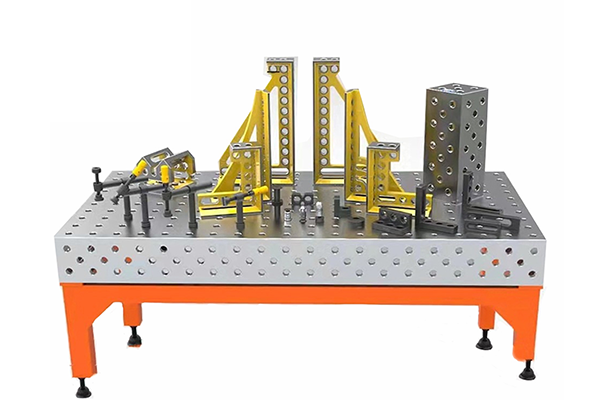
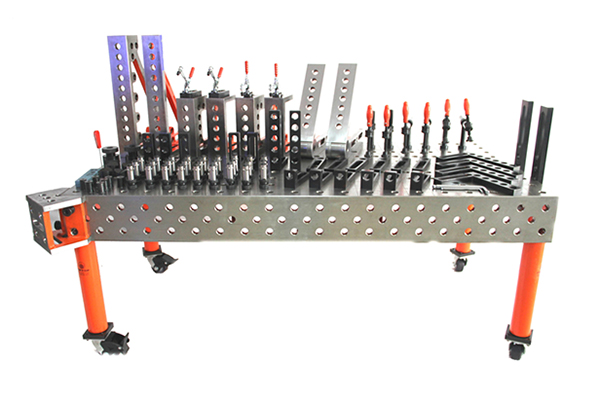
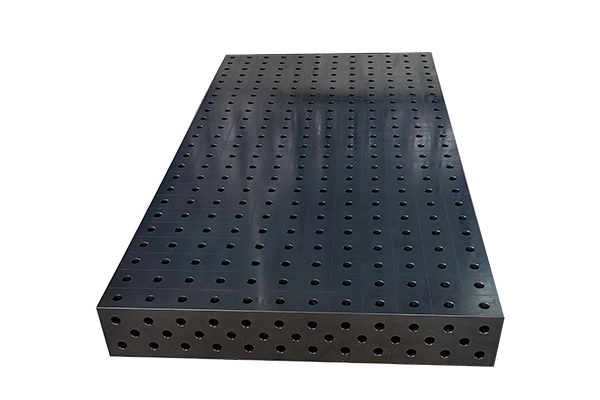
A Hole-based Flexible Welding Platform is a modular fixturing table system featuring a standardized grid of precision-machined holes. These holes allow operators to mount locating pins, clamps, blocks, and supports in various configurations to secure workpieces during welding.
Unlike traditional dedicated fixtures, this platform allows quick reconfiguration for different product geometries. Manufacturers can adapt layouts without rebuilding tooling, improving production flexibility while maintaining high positioning accuracy.
In industrial production lines, the hole grid becomes a universal reference system. Each hole provides a repeatable datum point, enabling fast setup and reliable assembly for both manual and robotic welding operations.
Structural Design of a Hole-based Flexible Welding Platform
The effectiveness of a Hole-based Flexible Welding Platform depends on its precise and durable structure. Several design components work together to ensure stability and flexibility.
Precision Hole Grid System
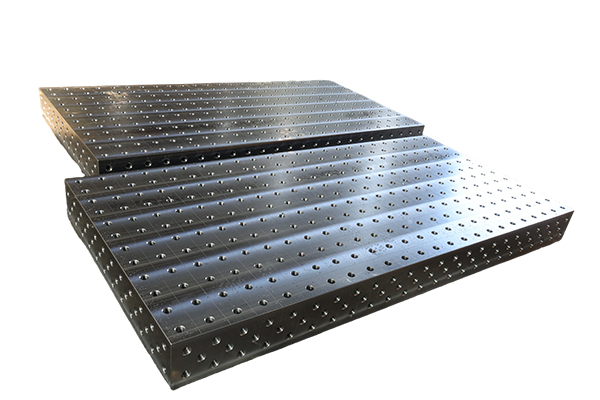
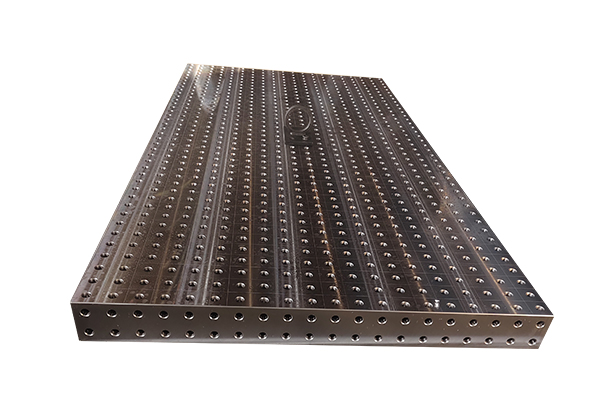
The platform surface is machined with evenly spaced holes, typically arranged in a metric grid pattern. Each hole is manufactured with tight tolerances to ensure consistent pin and clamp positioning.
This grid allows welders to build three-dimensional fixtures directly on the table, reducing setup time and eliminating the need for custom tooling for every product.
High-Strength Platform Body
The main body is usually made from hardened steel or similar materials to maintain flatness and load capacity. In production environments, the platform must resist thermal distortion and mechanical stress caused by welding heat and heavy components.
A stable platform body ensures dimensional consistency during repeated welding cycles.
Modular Fixture Elements
The platform works with modular components such as:
·Locating pins
·Support blocks
·Clamps
·Angle brackets
·Riser elements
These elements can be repositioned through the hole grid to create custom fixture structures for different workpieces without changing the main table.
Functional Principles in Welding Production
The Hole-based Flexible Welding Platform operates on three core functional principles: positioning, clamping, and repeatability.
Accurate Positioning
Each hole acts as a reference point, allowing components to be placed at precise coordinates. This eliminates guesswork in setup and ensures consistent part alignment from batch to batch.
For robotic welding, accurate positioning is essential. The hole-based system ensures the robot path remains stable across multiple production cycles.
Stable Clamping
Clamping elements lock parts firmly in place, reducing movement caused by welding heat or vibration. Proper clamping minimizes distortion and improves weld seam consistency.
Stable support also helps protect component geometry, especially in large or complex assemblies.
High Repeatability
Repeatability is critical in factory-level production. Once a fixture layout is established on the Hole-based Flexible Welding Platform, it can be reused repeatedly with identical results.
This reduces setup time, operator dependency, and production errors.
Advantages of Hole-based Flexible Welding Platform Systems
Improved Production Efficiency
Fast fixture reconfiguration shortens setup time between projects. Operators can change layouts in minutes instead of hours, increasing line utilization and output capacity.
Enhanced Welding Accuracy
The precise hole grid improves positioning accuracy, leading to consistent weld quality and reduced rework.
Flexible Manufacturing Capability
With one platform, multiple product types can be processed. This supports small-batch, multi-model manufacturing without investing in dedicated tooling for each product.
Cost Control in Factory Production
Instead of producing custom fixtures for every part, the modular approach lowers tooling cost while maintaining industrial-level performance.
Compatibility with Automation
Hole-based Flexible Welding Platform systems integrate easily with robotic welding cells, improving automation efficiency and long-term production stability.
Applications in Industrial Manufacturing
A Hole-based Flexible Welding Platform is widely used in:
·Automotive frame welding
·Machinery fabrication
·Structural steel assembly
·Sheet metal processing
·Equipment chassis production
In large-scale production workshops, the platform supports standardized processes while allowing flexibility for product updates and design changes.
As a professional Production-oriented Manufacturer and Factory supplier, large-volume manufacturing of these platforms ensures consistent machining quality and reliable long-term performance in demanding environments.
How Hole-based Flexible Welding Platforms Support Modern Factories
Modern factories focus on lean production and fast response to market demand. The Hole-based Flexible Welding Platform supports this goal by combining precision with adaptability.
Instead of rigid tooling systems, manufacturers can adjust fixture layouts quickly, respond to new product designs, and reduce downtime between batches.
This flexibility makes the platform suitable for both prototype development and mass production, bridging the gap between engineering and industrial manufacturing.
Future Development Trends
With increasing automation and smart manufacturing, Hole-based Flexible Welding Platform systems are evolving toward:
·Higher positioning accuracy
·Improved surface treatments
·Better integration with robotic systems
·Enhanced modular component libraries
These improvements further strengthen their role in advanced welding production environments.
Conclusion
A Hole-based Flexible Welding Platform is a key infrastructure tool in modern welding production. Its precision hole grid, modular structure, and repeatable positioning enable efficient, accurate, and flexible manufacturing processes.
For industrial workshops and automated factories, this platform reduces setup time, improves weld quality, and supports scalable production.
Backed by professional Manufacturer capability and Factory-level Production supply, Hole-based Flexible Welding Platform systems continue to drive efficiency and innovation across the welding industry.
By combining engineering accuracy with operational flexibility, this platform remains an essential solution for manufacturers seeking long-term performance and competitive production efficiency.
References
GB/T 7714:Asada H. Kinematic analysis of workpart fixturing for flexible assembly with automatically reconfigurable fixtures[J]. IEEE Journal on Robotics and Automation, 2003, 1(2): 86-94.
MLA:Asada, Haruhiko. "Kinematic analysis of workpart fixturing for flexible assembly with automatically reconfigurable fixtures." IEEE Journal on Robotics and Automation 1.2 (2003): 86-94.
APA:Asada, H. (2003). Kinematic analysis of workpart fixturing for flexible assembly with automatically reconfigurable fixtures. IEEE Journal on Robotics and Automation, 1(2), 86-94.
 Recommended Products
 Contact Us
—— Hotline:+86 13833738896
—— Hotline:+86 17332777263
—— Email:gongliliangju@163.com
—— Whatsapp:+8615832706206
—— Whatsapp:+8615931710409
—— Address:Beihan Village, Haocun Town, Botou City, Cangzhou City, Hebei Province, China