





NewsDetails
Hole-based Flexible Welding Platform in Industrial Production
author:jinchang time:2026-03-07 09:56:48 click:91
In modern manufacturing environments, efficiency, precision, and adaptability are essential for successful welding operations. As product structures become more complex and production cycles become shorter, traditional fixed welding tables are no longer sufficient. This is where the Hole-based Flexible Welding Platform plays an important role in industrial production.
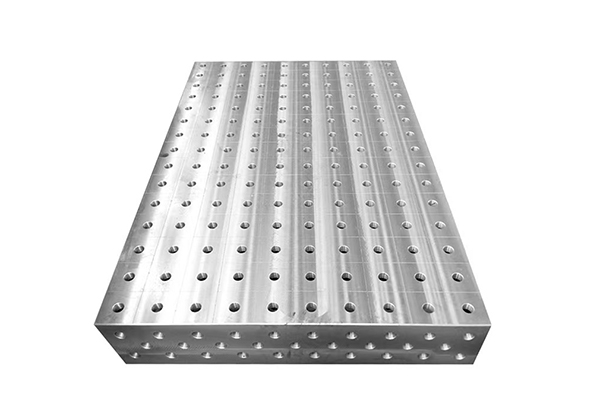
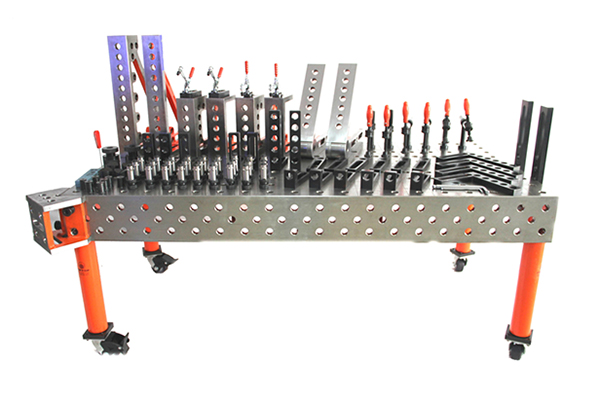
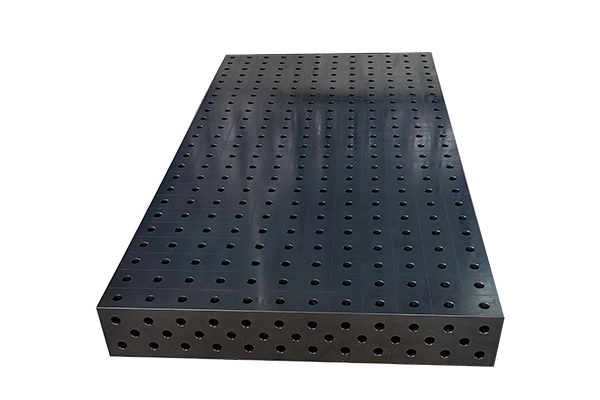
A Hole-based Flexible Welding Platform is designed with a standardized hole grid on the working surface, allowing operators to install locating pins, clamps, angles, and supports quickly. Instead of relying on custom-made fixtures, users can build flexible welding setups directly on the platform. This structure improves accuracy, reduces setup time, and supports stable welding for a wide range of workpieces.
For modern manufacturers and factory production lines, adopting a hole-based flexible system helps achieve consistent quality while improving overall productivity.

What Is a Hole-based Flexible Welding Platform?
A Hole-based Flexible Welding Platform is a modular welding table system that uses evenly distributed precision holes across the surface. These holes serve as reference points for positioning, clamping, and supporting parts during welding.
Unlike traditional flat tables, hole-based platforms allow quick configuration. Operators can combine different tooling elements to match the geometry of the workpiece. Whether welding frames, pipes, brackets, or structural assemblies, the platform provides a stable base for accurate positioning.
The platform surface is usually made from high-strength steel or cast materials with excellent flatness and rigidity. This ensures resistance to thermal deformation and long-term durability in continuous welding production environments.
Advantages of Hole-based Structure in Welding
The hole-based design is the core feature of this flexible welding platform. Each hole acts as a precise locating point, ensuring that parts remain aligned during welding.
One major advantage is repeatability. Once a fixture layout is built, it can be reused for the next batch without redesign. This is essential for industrial production where dimensional consistency is required.
Another advantage is stability. During welding, heat causes material expansion and contraction. The hole-based clamping system holds parts firmly in place, reducing distortion and improving weld quality.
For factories handling batch and mass production, this structure helps maintain consistent results across different projects.
Faster Setup and Higher Production Efficiency
Traditional welding fixtures often require long preparation times. Designing and manufacturing fixed jigs is costly and inflexible. With a Hole-based Flexible Welding Platform, setup becomes faster and more efficient.
Operators simply install positioning pins and clamps into the hole pattern according to the workpiece shape. If a design changes, adjustments can be made quickly without rebuilding the entire fixture system.
This flexibility significantly shortens preparation time and increases actual welding time. For production workshops facing tight schedules, a hole-based modular platform provides a clear productivity advantage.
Flexibility for Multiple Welding Applications
Industrial welding covers many applications: machinery frames, vehicle parts, pipelines, enclosures, and structural steel. A Hole-based Flexible Welding Platform supports all these needs with one system.
Because tooling elements are interchangeable, the same platform can be adapted for different workpieces. This reduces the need for multiple specialized tables and lowers investment costs.
From small batch customization to large-scale factory production, the flexible welding platform allows manufacturers to respond quickly to changing orders and technical requirements.
Cost Control in Manufacturing Production
Although the initial investment in a Hole-based Flexible Welding Platform may be higher than a simple table, the long-term savings are significant.
First, tooling reuse reduces the cost of producing new fixtures for every project. Second, faster setup lowers labor hours. Third, better positioning reduces welding errors and rework.
For a factory manufacturer focused on continuous production, these savings accumulate over time, improving profitability and operational stability.
Additionally, modular components require less storage space compared with bulky custom fixtures, further optimizing workshop management.
Improved Quality and Welding Consistency
Quality control is critical in industrial welding. The Hole-based Flexible Welding Platform improves quality by ensuring stable positioning and accurate referencing.
With fixed hole coordinates, each part is located in the same position every time. This improves seam consistency, reduces deformation, and enhances the appearance and strength of weld joints.
Inspectors also benefit because repeatable positioning simplifies measurement and dimensional verification.
For production-oriented factories, this consistency supports long-term customer satisfaction and reduces the risk of quality disputes.
Compatibility with Automation and Smart Production
As manufacturing evolves toward automation, welding platforms must support robotic and semi-automatic processes. A Hole-based Flexible Welding Platform integrates well with robotic welding systems.
The standardized hole layout allows easy integration with robot arms, sensors, and automated clamps. This helps factories upgrade from manual welding to intelligent production lines without replacing the entire infrastructure.
For manufacturers planning long-term development, a hole-based platform provides scalability and future-proof production capability.
Why Hole-based Flexible Welding Platform Suits Factory Supply
From a manufacturer and factory supply perspective, the Hole-based Flexible Welding Platform supports stable output, batch production, and flexible scheduling.
It reduces dependency on custom tooling while increasing adaptability. Standardized components ensure consistency across different projects and production volumes.
Whether used for prototype development or bulk industrial manufacturing, the hole-based system strengthens competitiveness and improves overall workflow efficiency.
Conclusion: Value of Hole-based Flexible Welding Platform
The Hole-based Flexible Welding Platform is a practical and efficient solution for modern industrial welding production. By combining precision, flexibility, and repeatability, it helps manufacturers improve accuracy, reduce setup time, and control production costs.
For factories aiming to enhance productivity and maintain consistent quality, investing in a Hole-based Flexible Welding Platform is a strategic choice. From small projects to large-scale production, this system supports stable welding operations and long-term manufacturing growth.
As industrial demands continue to increase, the Hole-based Flexible Welding Platform will remain an essential foundation for efficient, reliable, and scalable welding production.
References
GB/T 7714:Darmawan T D, Priadythama I, Herdiman L. Conceptual design of modular fixture for frame welding and drilling process integration case study: Student chair in UNS industrial engineering integrated practicum[C]//AIP Conference Proceedings. AIP Publishing LLC, 2018, 1931(1): 030033.
MLA:Darmawan, Tofiq Dwiki, Ilham Priadythama, and Lobes Herdiman. "Conceptual design of modular fixture for frame welding and drilling process integration case study: Student chair in UNS industrial engineering integrated practicum." AIP Conference Proceedings. Vol. 1931. No. 1. AIP Publishing LLC, 2018.
APA:Darmawan, T. D., Priadythama, I., & Herdiman, L. (2018, February). Conceptual design of modular fixture for frame welding and drilling process integration case study: Student chair in UNS industrial engineering integrated practicum. In AIP Conference Proceedings (Vol. 1931, No. 1, p. 030033). AIP Publishing LLC.
 Recommended Products
 Contact Us
—— Hotline:+86 13833738896
—— Hotline:+86 17332777263
—— Email:gongliliangju@163.com
—— Whatsapp:+8615832706206
—— Whatsapp:+8615931710409
—— Address:Beihan Village, Haocun Town, Botou City, Cangzhou City, Hebei Province, China