





NewsDetails
Flexible Modular Fixturing System vs Traditional Fixtures in Modern Production
author:jinchang time:2026-03-10 09:56:56 click:66
In today’s competitive manufacturing environment, precision, speed, and flexibility determine production success. As product designs become more diverse and batch sizes change frequently, conventional tooling methods struggle to keep up. This is why the Flexible Modular Fixturing System is increasingly replacing traditional fixtures in industrial production.
A Flexible Modular Fixturing System allows manufacturers to build adaptable setups using standardized modules instead of relying on fixed, custom-made fixtures. Compared with traditional fixtures, this system provides higher efficiency, better repeatability, and lower long-term costs. For modern manufacturer-driven production and factory-scale supply, choosing the right fixturing solution has become a strategic decision rather than a simple tooling choice.
What Is a Flexible Modular Fixturing System?
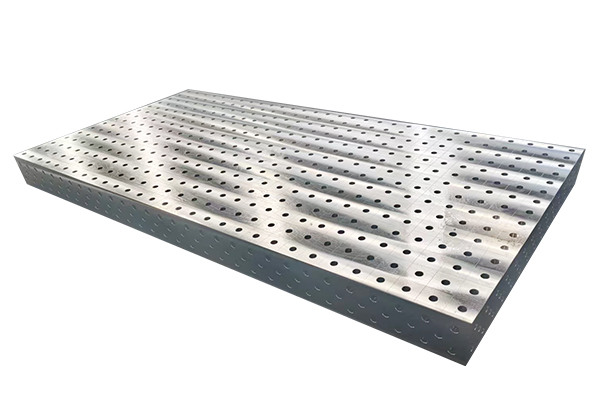
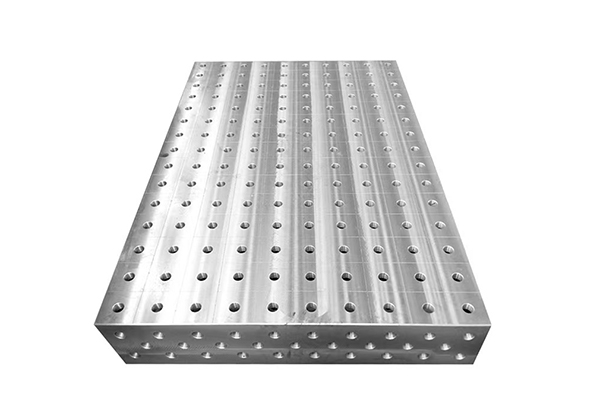
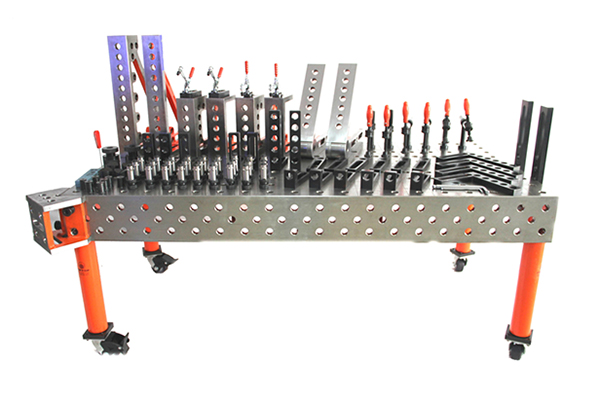
A Flexible Modular Fixturing System is a configurable platform composed of standardized locating elements, clamps, risers, angles, and base plates. These components can be assembled in different ways to hold workpieces during welding, machining, inspection, or assembly.
Instead of designing a new fixture for every part, operators can rearrange modules according to the workpiece geometry. This allows quick adaptation to design changes and different product models.
The base structure is usually manufactured from high-strength steel or cast materials with precise reference grids. This ensures long-term dimensional stability under industrial production conditions such as heat, vibration, and repeated loading.
Understanding Traditional Fixtures
Traditional fixtures are usually custom-built for a specific part. They are designed once and rarely modified. While they offer strong rigidity and accuracy for mass production of a single product, they lack flexibility.
Each new part design requires a new fixture, which involves engineering time, manufacturing cost, and storage space. Setup changes are slow, and reusing existing fixtures for different products is difficult.
In modern factory environments where product cycles are shorter and customization is common, traditional fixtures often become bottlenecks rather than productivity tools.
Setup Time and Production Efficiency
One major difference between a Flexible Modular Fixturing System and traditional fixtures is setup speed.
Traditional fixtures require long preparation periods. Designing, machining, and installing a dedicated fixture may take days or weeks. If the product changes, the fixture becomes obsolete.
By contrast, a Flexible Modular Fixturing System allows operators to assemble a setup directly on the platform using standardized modules. Adjustments can be made in minutes.
This reduces non-productive time and increases actual manufacturing output. For factory production lines handling multiple models, modular fixturing delivers a clear efficiency advantage.
Accuracy and Repeatability Comparison
Accuracy is essential in industrial production. Both traditional fixtures and modular systems aim to position parts correctly, but their approaches differ.
Traditional fixtures achieve accuracy through permanent geometry. Once built, the positioning is fixed. This works well for stable, long-term production runs.
A Flexible Modular Fixturing System achieves accuracy through standardized reference points. Locating pins and clamps are placed using precise grid patterns, ensuring repeatable positioning every time the setup is rebuilt.
This repeatability is especially valuable for batch production, where consistency across multiple runs is required without redesigning tooling.
Flexibility for Changing Manufacturing Demands
Modern manufacturers rarely produce only one product for years. Designs change, volumes fluctuate, and customization increases.
Traditional fixtures struggle in this environment because they are dedicated to one part shape. Any change requires new tooling.
A Flexible Modular Fixturing System adapts easily. The same components can support frames, brackets, enclosures, pipelines, and structural assemblies by rearranging modules.
For factory supply and manufacturer production planning, this flexibility reduces risk and allows faster response to customer demands.
Cost Structure and Long-Term Value
From a financial perspective, traditional fixtures often appear cheaper at first. However, hidden costs accumulate over time. These include engineering hours, storage, rework, and downtime caused by inflexible tooling.
A Flexible Modular Fixturing System represents an investment, but it generates long-term savings:
Reduced tooling redesign
Lower labor hours for setup
Less rework from positioning errors
Reusable components for multiple projects
For a manufacturer focused on continuous production and factory efficiency, modular fixturing improves overall return on investment.
Quality Control and Consistency
Quality control depends heavily on consistent part positioning.
Traditional fixtures provide stable positioning but only for the part they are designed for. When new fixtures are built, variation can occur between designs.
A Flexible Modular Fixturing System uses standardized elements, reducing variation between setups. Once a proven layout is created, it can be reused across batches, improving dimensional consistency and weld quality.
This consistency supports better inspection results, fewer defects, and higher customer satisfaction in industrial production.
Integration with Automation and Smart Production
Automation is transforming manufacturing. Fixtures must now work with robots, sensors, and automated clamping.
Traditional fixtures often require modification to integrate into robotic systems. Their fixed geometry limits flexibility in automated environments.
A Flexible Modular Fixturing System is more compatible with automation because its structure is standardized. It integrates easily with robotic welding, CNC machining, and intelligent production lines.
For factories planning long-term upgrades, modular fixturing provides scalability without replacing the entire infrastructure.
When to Choose Modular Over Traditional
Traditional fixtures still make sense for very high-volume, stable products with no design changes.
However, for most modern industrial applications involving mixed production, customization, or frequent updates, a Flexible Modular Fixturing System offers greater advantages.
It supports faster setup, adaptable production, cost control, and quality consistency — all essential for competitive manufacturing environments.
Conclusion: The Role of Flexible Modular Fixturing System
The Flexible Modular Fixturing System represents a shift from rigid tooling to adaptive production solutions. Compared with traditional fixtures, it provides superior flexibility, reduced setup time, repeatable accuracy, and long-term cost benefits.
For manufacturers seeking higher efficiency and smarter factory production, modular fixturing is no longer optional — it is a strategic tool. From prototype development to bulk industrial supply, the Flexible Modular Fixturing System supports scalable, reliable, and future-ready manufacturing operations.
As industrial demands continue to evolve, adopting a Flexible Modular Fixturing System ensures production remains competitive, efficient, and responsive to market change.
References
GB/T 7714:Liu C. A systematic conceptual design of modular fixtures[J]. The International Journal of Advanced Manufacturing Technology, 1994, 9(4): 217-224.
MLA:Liu, Cheng-liang. "A systematic conceptual design of modular fixtures." The International Journal of Advanced Manufacturing Technology 9.4 (1994): 217-224.
APA:Liu, C. L. (1994). A systematic conceptual design of modular fixtures. The International Journal of Advanced Manufacturing Technology, 9(4), 217-224.
 Recommended Products
 Contact Us
—— Hotline:+86 13833738896
—— Hotline:+86 17332777263
—— Email:gongliliangju@163.com
—— Whatsapp:+8615832706206
—— Whatsapp:+8615931710409
—— Address:Beihan Village, Haocun Town, Botou City, Cangzhou City, Hebei Province, China