





NewsDetails
Flexible Modular Fixturing System for Modern Welding
author:jinchang time:2026-02-20 17:48:35 click:162
Modern fabrication demands higher accuracy, faster turnaround, and repeatable quality. As welding applications become more complex, traditional fixed jigs struggle to keep up with frequent product changes and tight tolerances. This is where the Flexible Modular Fixturing System becomes essential for today’s production environments.
A Flexible Modular Fixturing System is a reconfigurable platform used to position, support, and secure workpieces during welding and fabrication. Unlike permanent fixtures, modular systems allow users to assemble, adjust, and reuse components for different projects. Supported by professional manufacturer experience and factory production capacity, these systems are now widely used in automotive, machinery, structural steel, and robotic welding lines.
By integrating modularity with precision manufacturing, production facilities gain better control over quality, efficiency, and scalability.
What Is a Flexible Modular Fixturing System?
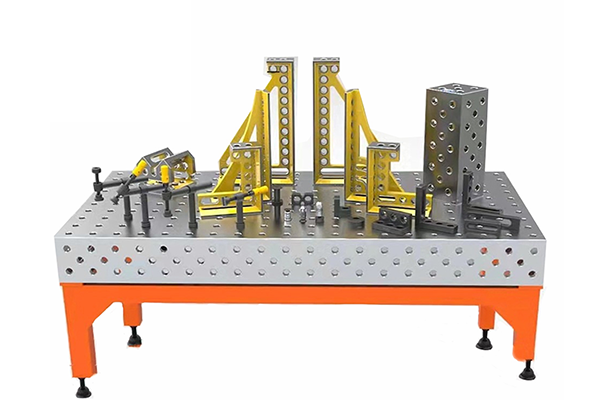
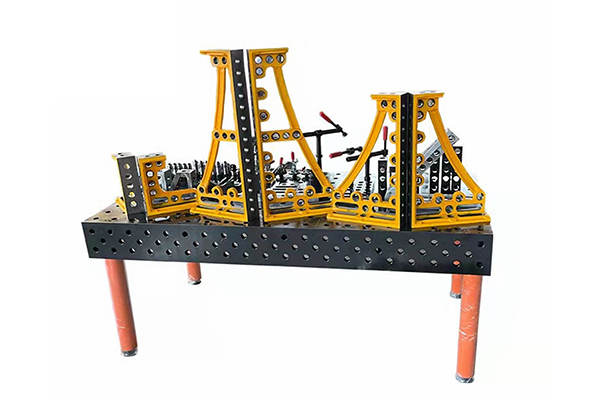
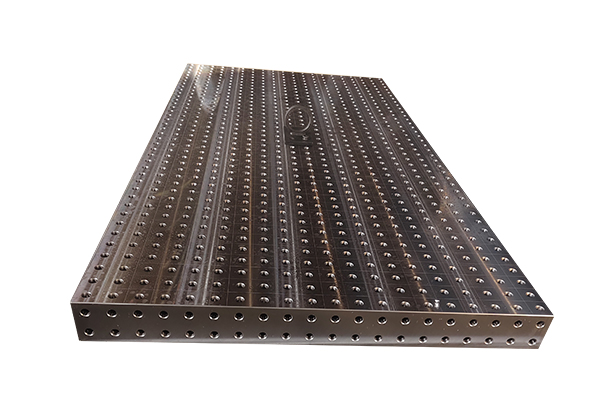
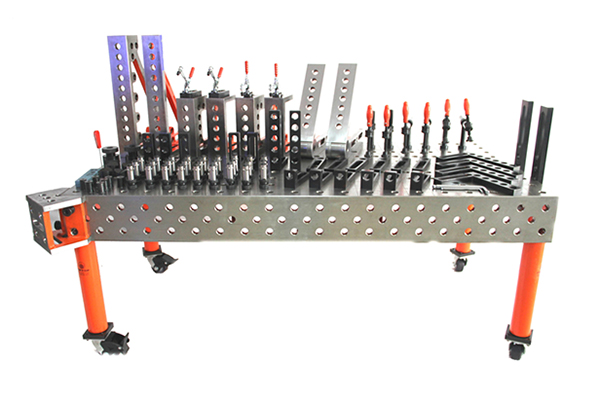
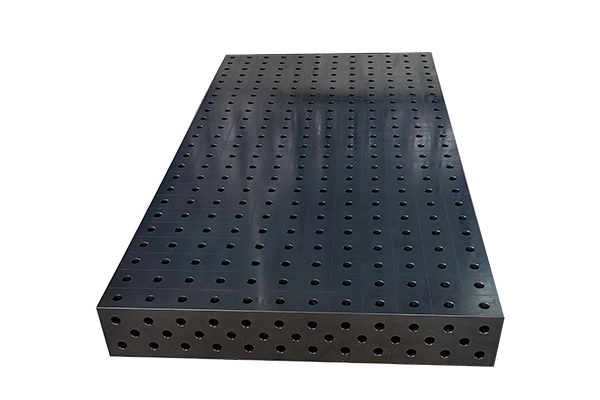
A Flexible Modular Fixturing System consists of standardized tables, locating pins, clamps, risers, blocks, and accessories that can be assembled into custom fixture layouts. These elements are machined with high positional accuracy, allowing users to build repeatable welding setups quickly.
Instead of designing a single-use jig, operators configure a modular welding fixturing system to match the part geometry. After welding, the setup can be disassembled and reused for the next project. This flexibility makes it ideal for short production runs and large-scale industrial manufacturing alike.
Factory production ensures that each component maintains consistent hole spacing, surface flatness, and load capacity, which are critical for accurate part positioning in welding operations.
Why Modern Welding Needs Modular Fixturing
Traditional welding fixtures are rigid, costly, and time-consuming to modify. In contrast, a Flexible Modular Fixturing System supports dynamic production demands.
Key reasons modern workshops adopt modular systems include:
·High repeatability for consistent weld quality
·Fast setup and changeover between different parts
·Reduced tooling cost over time
·Improved accuracy through precision-machined surfaces
·Better compatibility with robotic welding automation
With stable production processes from a professional manufacturer, modular fixturing improves operational efficiency while lowering total fabrication cost.
Applications in Industrial Welding
1. Automotive and Transportation
Automotive frames, brackets, and chassis parts require precise positioning before welding. A Flexible Modular Fixturing System allows fast reconfiguration for different models and sizes.
Production-level fixturing ensures repeatable accuracy for high-volume automotive manufacturing. Factory-supplied modular components support both manual and robotic welding lines.
2. Heavy Machinery Fabrication
Heavy equipment parts are large and irregular in shape. Modular welding fixturing systems provide strong clamping force and adjustable positioning for complex structures.
Through factory production and quality inspection, fixturing components handle high loads while maintaining alignment stability during welding.
3. Structural Steel and Frames
Steel beams, platforms, and frames require accurate geometry. Flexible modular systems enable fabricators to align parts quickly and maintain consistent weld seams.
Manufacturers offering batch production of modular fixturing tables allow construction and infrastructure projects to scale efficiently.
4. Robotic Welding Cells
Automation depends heavily on positioning accuracy. A Flexible Modular Fixturing System integrates easily into robotic welding cells, providing repeatable coordinates for programming and motion control.
With precision factory machining, modular systems support long-term robotic accuracy and reduced calibration time.
Performance Advantages of Flexible Modular Fixturing
Using a Flexible Modular Fixturing System in production delivers several benefits:
·Precision Positioning – Maintains part geometry before and during welding.
·Shock and Heat Resistance – Designed to withstand welding heat and vibration.
·Reusability – One system supports multiple projects.
·Time Savings – Faster setup improves production throughput.
·Scalability – Manufacturer production allows batch supply for expanding operations.
Compared with traditional fixtures, modular systems offer higher return on investment and operational flexibility.
Manufacturing and Production Quality
The effectiveness of a Flexible Modular Fixturing System depends on its manufacturing quality. Professional factory production focuses on:
·CNC machining of table surfaces and holes
·Surface hardening and anti-spatter treatment
·Load testing and flatness inspection
·Modular compatibility verification
·Consistent batch production control
A reliable Flexible Modular Fixturing System Manufacturer and Factory Production process ensures every component fits accurately and performs consistently under welding conditions.
With scalable production capability, factories can supply modular systems in bulk while maintaining strict dimensional tolerances.
Choosing the Right Modular Fixturing System
When selecting a Flexible Modular Fixturing System, fabricators should consider:
·Table size and hole pattern
·Load-bearing capacity
·Material and surface treatment
·Compatibility with automation
·Manufacturer production capability and supply stability
Partnering with a factory-oriented manufacturer provides long-term support, customization, and efficient production scheduling for industrial welding needs.
Conclusion: The Future of Welding Fixturing
The Flexible Modular Fixturing System has become a foundation of modern welding production. Its modular design, precision manufacturing, and scalable factory production support efficient, accurate, and repeatable fabrication.
From automotive and machinery to structural steel and robotic welding, modular fixturing improves quality while reducing setup time and cost. Backed by professional manufacturer expertise and factory-level production, Flexible Modular Fixturing Systems continue to drive productivity in modern fabrication environments.
With reliable production processes and batch supply capability, the Flexible Modular Fixturing System remains a key solution for advanced welding operations.
References
GB/T 7714:Liu C. A systematic conceptual design of modular fixtures[J]. The International Journal of Advanced Manufacturing Technology, 1994, 9(4): 217-224.
MLA:Liu, Cheng-liang. "A systematic conceptual design of modular fixtures." The International Journal of Advanced Manufacturing Technology 9.4 (1994): 217-224.
APA:Liu, C. L. (1994). A systematic conceptual design of modular fixtures. The International Journal of Advanced Manufacturing Technology, 9(4), 217-224.
 Recommended Products
 Contact Us
—— Hotline:+86 13833738896
—— Hotline:+86 17332777263
—— Email:gongliliangju@163.com
—— Whatsapp:+8615832706206
—— Whatsapp:+8615931710409
—— Address:Beihan Village, Haocun Town, Botou City, Cangzhou City, Hebei Province, China