






NewsDetails
Customized Flexible Welding Solution for Complex Parts
author:jinchang time:2026-03-13 10:25:43 click:157
In today’s manufacturing industry, product structures are becoming increasingly complex. From automotive frames and machinery components to aerospace parts and industrial assemblies, manufacturers face higher demands for precision, repeatability, and efficiency. Traditional fixed welding setups often struggle to adapt to these challenges. That is why a Customized Flexible Welding Solution has become essential for welding complex parts with high accuracy and productivity.
As a professional Customized Flexible Welding Solution Manufacturer with standardized production capability and bulk supply capacity, advanced welding systems are designed to handle diverse part geometries, variable batch sizes, and strict quality requirements. With strong production management and engineering support, customized flexible welding solutions help modern factories achieve consistent results across multiple applications.
This article explains what a customized flexible welding solution is, why it matters for complex parts, its design structure, key advantages, and how it supports scalable industrial production.
What Is a Customized Flexible Welding Solution?
A Customized Flexible Welding Solution is an integrated welding system designed according to specific product geometry, production volume, and process requirements. Unlike traditional single-purpose fixtures, flexible welding solutions combine modular fixtures, adjustable welding tables, robotic welding, and smart positioning systems to adapt to different part configurations.
Core elements often include:
·Modular welding tables and fixtures
·Adjustable clamps and locating systems
·Robotic or manual welding integration
·Positioners and manipulators
·Digital setup and repeatability control
This approach allows manufacturers to switch between products quickly while maintaining high welding accuracy and efficiency.
Why Complex Parts Need Flexible Welding Solutions
1. Adaptability to Irregular Geometry
Complex parts often feature multiple angles, curves, and varying thicknesses. Fixed jigs cannot easily accommodate such diversity.
A customized flexible welding solution allows components to be repositioned, clamped, and aligned accurately regardless of shape. Modular elements enable fast reconfiguration, making it easier to handle different designs without rebuilding the entire setup.
This adaptability significantly improves welding accuracy for complex structures.
2. Improved Positioning and Accuracy
Welding quality depends heavily on positioning. Even minor misalignment can cause dimensional errors, distortion, or assembly problems.
Flexible welding systems use precision-machined reference surfaces, locating pins, and adjustable stops to ensure repeatable positioning. By controlling part geometry before welding begins, a customized solution minimizes variation and improves overall product consistency.
3. Reduced Distortion and Rework
Complex parts are more sensitive to thermal deformation. When heat is applied unevenly, warping and stress buildup occur.
A customized flexible welding solution holds parts securely and distributes heat effects more evenly during the welding process. This reduces distortion, minimizes post-weld correction, and lowers scrap rates, which is critical for cost control in production environments.
4. Higher Productivity and Shorter Setup Time
In traditional welding, setup changes consume valuable production time.
With modular and flexible designs:
·Changeovers are faster
·Fixturing is simplified
·Operators spend less time measuring
·Production becomes more predictable
This makes customized flexible welding solutions ideal for both mass production and small-batch, high-mix manufacturing.
5. Scalability for Industrial Production
As product demand increases, production systems must scale without sacrificing quality.
A professional Customized Flexible Welding Solution Manufacturer with strong production and bulk supply capability ensures consistent design, standardized components, and repeatable processes. This allows factories to expand output while maintaining welding accuracy across multiple production lines.
Key Design Elements of a Customized Flexible Welding Solution
Modular Welding Tables
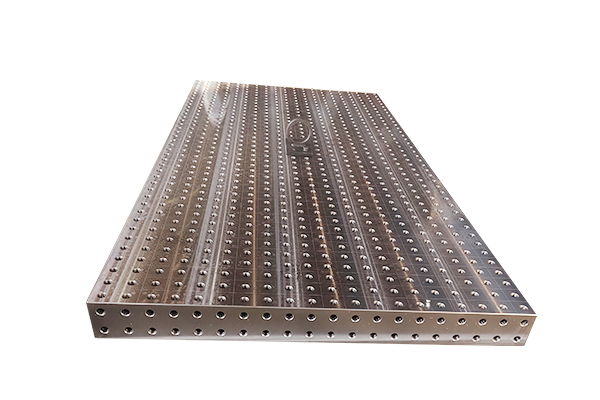
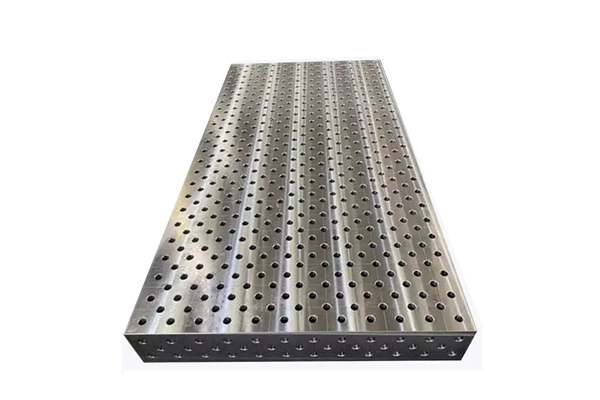
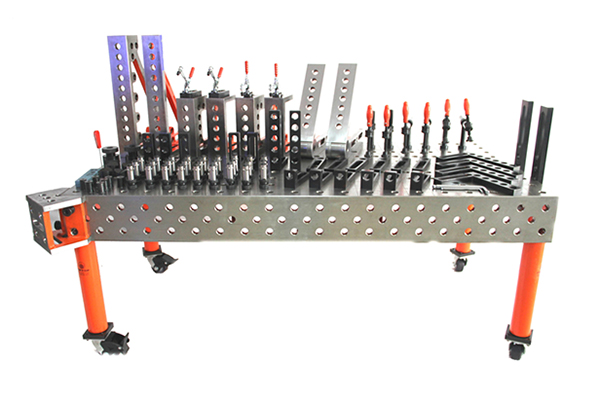
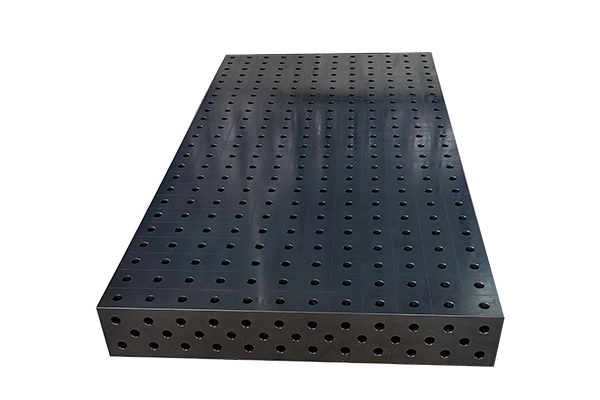
Precision welding tables with grid holes or T-slots form the base of flexible systems. They provide flat reference surfaces for accurate alignment and easy fixture integration.
Adjustable Fixtures and Clamps
Custom clamps and locating modules allow parts to be secured quickly while compensating for different shapes and sizes.
Positioners and Manipulators
Rotary and tilting positioners enable optimal welding angles, improving accessibility and weld quality while reducing operator fatigue.
Robotic and Manual Integration
Flexible welding solutions can integrate both robotic welding and manual processes. Robots improve repeatability, while manual stations provide adaptability for special tasks.
Digital Setup and Process Control
Advanced solutions incorporate digital design and setup verification to ensure that part placement and welding paths are consistent across batches.
Applications of Customized Flexible Welding Solutions
Customized flexible welding solutions are widely used in:
·Automotive structures and chassis
·Construction machinery parts
·Aerospace assemblies
·Industrial equipment frames
·Agricultural machinery
·Energy and power equipment
Wherever parts are complex and precision is required, flexible welding systems deliver measurable performance improvements.
How Customized Flexible Welding Solutions Improve Production
From a manufacturing perspective, flexible welding systems support:
·Higher dimensional accuracy
·Faster production cycles
·Reduced labor cost
·Lower defect rates
·Improved process standardization
A reliable Customized Flexible Welding Solution Manufacturer with advanced production systems and bulk supply support ensures every project meets industrial standards and delivery schedules.
By combining engineering design with scalable production, customized solutions help manufacturers remain competitive in modern markets.
Key Factors When Choosing a Customized Welding Solution
When selecting a customized flexible welding solution, consider:
·Product geometry and material type
·Production volume
·Required accuracy level
·Automation degree
·Future scalability
·Maintenance and training support
Working with an experienced manufacturer ensures the system matches real operational needs rather than just theoretical design.
Future Trends in Flexible Welding Technology
As smart manufacturing grows, customized flexible welding solutions are evolving toward:
·Greater automation
·AI-assisted path planning
·Digital twins for setup
·Modular expansion design
·Integrated quality monitoring
These trends allow flexible welding systems to handle increasingly complex parts with higher efficiency and reliability.
Conclusion: Customized Flexible Welding Solution as a Competitive Advantage
In modern fabrication, Customized Flexible Welding Solution is not simply a tool — it is a strategic production system for welding complex parts with accuracy and efficiency. By improving positioning, reducing distortion, and enabling rapid changeovers, flexible solutions transform how manufacturers approach welding.
Choosing a trusted Customized Flexible Welding Solution Manufacturer with stable production capability and reliable bulk supply ensures consistent quality, scalable output, and long-term operational success. Whether for small batches or mass production, customized flexible welding solutions provide the foundation for precision, productivity, and competitiveness in today’s industrial environment.
References
GB/T 7714:Gothwal S, Raj T. Different aspects in design and development of flexible fixtures: review and future directions[J]. International Journal of Services and Operations Management, 2017, 26(3): 386-410.
MLA:Gothwal, Suman, and Tilak Raj. "Different aspects in design and development of flexible fixtures: review and future directions." International Journal of Services and Operations Management 26.3 (2017): 386-410.
APA:Gothwal, S., & Raj, T. (2017). Different aspects in design and development of flexible fixtures: review and future directions. International Journal of Services and Operations Management, 26(3), 386-410.
 Recommended Products
 Contact Us
—— Hotline:+86 13833738896
—— Hotline:+86 17332777263
—— Email:gongliliangju@163.com
—— Whatsapp:+8615832706206
—— Whatsapp:+8615931710409
—— Address:Beihan Village, Haocun Town, Botou City, Cangzhou City, Hebei Province, China